
Commercial Fire Alarm Installation in London
BS 5839-1:2025 Compliant Commercial Fire Alarm Systems
Liviosiv provides professional commercial fire alarm installation, testing, servicing, maintenance, fault finding and system upgrades across London for businesses, landlords, managing agents, facilities managers and property professionals.
From a new commercial fire alarm system to routine servicing of an existing installation, we provide practical fire detection and alarm solutions based on the building, occupancy, fire risk assessment and required level of protection.
Our commercial fire alarm services cover offices, shops, restaurants, hotels, warehouses, schools, HMOs, apartment blocks, mixed-use developments and other commercial and managed premises throughout Greater London.
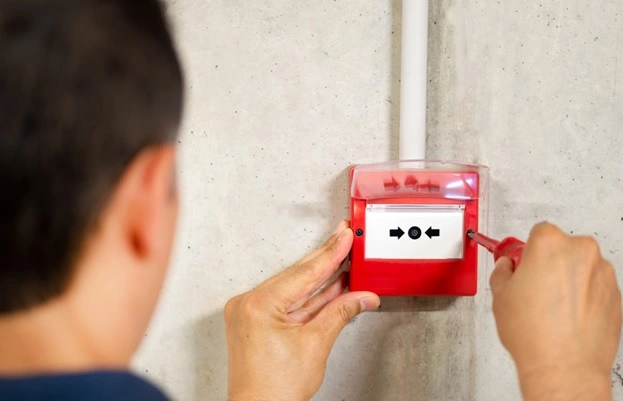
What Is Commercial Fire Alarm Installation?
Commercial fire alarm installation is the process of designing, installing, testing and commissioning a fire detection and alarm system suitable for a non-domestic or commercial building.
A properly designed system considers the building layout, occupancy, escape routes, fire hazards, fire risk assessment and required fire alarm category before equipment is selected.
Depending on the premises, a commercial fire alarm installation near me may include:
Fire alarm control and indicating equipment, Smoke detectors,Heat detectors, Multi-sensor detectors, Manual call points, Alarm sounders, Visual alarm devices where required, Standby power supplies, Interfaces with other building systems where applicable, Associated cabling or wireless equipment, System programming, Testing and commissioning, Handover documentation
Liviosiv can provide support from the initial site survey through installation, commissioning and ongoing maintenance.
Fire Alarm services
Fire Alarm Installation London
Fire Alarm Servicing London
Fire Alarm Maintenance London
Commercial Fire Alarm Installtion
Complete Landlord Safety Certificate Services
Electrical Safety Services
Fire Safety Services
Energy Performance Certificate
Gas Safety Certificate
Fire Risk Assessment
Asbestos Survey
Geographical Breakdown of London’s Districts
East London
South London
West London
North London
Central London
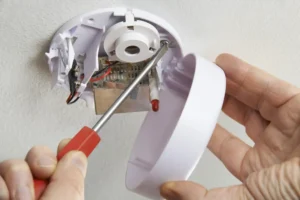
Commercial Fire Alarm Services in London
Liviosiv supports the full lifecycle of commercial fire detection and alarm systems, from initial installation through to routine servicing, repairs and future upgrades.
Commercial Fire Alarm Installation
We design, supply and install new commercial fire alarm systems based on the requirements of the individual premises.
The specification may include conventional, addressable, wireless or hybrid technology depending on the building and project requirements.
Commercial Fire Alarm Testing
We test existing commercial fire alarm systems to help establish whether devices and system components are operating correctly and identify faults requiring further attention.
Testing can include relevant detectors, manual call points, control equipment, warning devices and power supplies according to the system and scope of the visit.
Commercial Fire Alarm Servicing
Routine servicing helps ensure a fire alarm system remains operational and that developing faults are identified before they compromise system performance.
We provide scheduled commercial fire alarm servicing across London for individual premises and multi-property portfolios.
Commercial Fire Alarm Maintenance
Our maintenance service provides ongoing support for existing fire alarm systems, including inspection, testing, fault investigation and appropriate repair or replacement work where required.
Fire Alarm Repairs And Fault Finding
If your fire alarm panel is showing a fault, devices are not responding correctly or the system is experiencing repeated problems, we can investigate the cause and recommend appropriate corrective action.
Fire Alarm Upgrades And Replacement
Existing systems can sometimes be extended or upgraded rather than completely replaced.
Where equipment has become obsolete, the building has changed significantly or the existing system no longer provides suitable protection, we can assess the installation and recommend an appropriate upgrade or replacement solution.
Our Complete Landlord Safety Certificate Services in London
Gas Safety Certificate
Certified EICR inspections to ensure your property’s wiring is safe, compliant, and legally approved.
Fire Safety Services
Complete fire safety inspections, alarms, and compliance solutions to protect your property and occupants.
Energy Performance Certificate (EPC)
Fast and accurate EPC assessments to rate your property’s energy efficiency and meet legal requirements.
Asbestos Survey
Professional asbestos surveys to identify risks and ensure full compliance with UK safety regulations.
Inventory Services
Detailed property inventory reports with photos to protect landlords, agents, and tenants.
Legionella Services
Legionella risk assessments and water testing to maintain safe and compliant water systems.
Why Do London Businesses Need a Compliant Fire Alarm System?
A commercial fire alarm system provides early warning of fire so occupants can respond and evacuate before conditions become dangerous.
The correct level of fire detection cannot be determined simply by the size of a property. Building use, occupancy, escape routes, sleeping risk, fire hazards and the findings of the fire risk assessment all need to be considered.
What Does the Law Require?
Under the Regulatory Reform (Fire Safety) Order 2005, the Responsible Person for most non-domestic premises must take appropriate general fire precautions and carry out a suitable and sufficient assessment of fire risks.
The fire risk assessment helps determine what fire detection and warning arrangements are appropriate for the premises. Full guidance on employer and business duties under the Order is available directly from GOV.UK’s workplace fire safety guidance.
Commercial fire alarm systems are commonly designed, installed, commissioned and maintained with reference to BS 5839-1, which provides recommendations for fire detection and fire alarm systems in non-domestic premises.
What Happens If a Fire Alarm System Is Inadequate?
An inadequate, poorly maintained or defective fire alarm system can create serious risks for occupants and the Responsible Person.
Depending on the circumstances, problems can lead to:
- Increased risk to occupants
- Fire safety deficiencies
- Enforcement action
- Delays in resolving licensing or compliance matters
- Insurance complications
- Business disruption
- Increased liability following a fire
- Failure to address recommendations within a fire risk assessment
Regular inspection, testing and maintenance help ensure problems are identified before an emergency occurs.
What Types of Commercial Fire Alarm Systems Are Available?
The correct system technology depends on the size and complexity of the building, existing infrastructure, required detection coverage and operational requirements.
Conventional Fire Alarm Systems: A conventional fire alarm system divides a property into detection zones.
When a detector or manual call point activates, the control panel identifies the affected zone rather than necessarily identifying the exact individual device.
Conventional systems can provide a practical solution for smaller and relatively straightforward commercial premises.
Addressable Fire Alarm Systems: An addressable fire alarm system allows individual devices to be assigned unique addresses that can be identified at the control panel.
This allows building management or responding personnel to locate an activation or fault more precisely.
Addressable systems are particularly useful in larger, multi-storey or more complex premises containing many detection devices.
Wireless Fire Alarm Systems: Wireless fire alarm systems use radio communication between compatible system components, reducing the requirement for extensive cabling.
They can be particularly useful for:
Listed buildings, Heritage properties, Occupied offices, Hotels, Existing commercial buildings, Properties where extensive cabling would cause significant disruption
Wireless does not automatically mean that a system is appropriate for every property. The building and fire safety requirements still need to be assessed before specifying equipment.
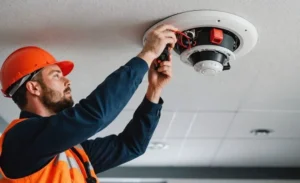
Our Fire Alarm Installation Process
Initial Enquiry and Property Details
Site Survey, Floor Plan Review or Existing System Check
System Design, Detector Layout and Written Specification
Professional Installation by Qualified Fire Alarm Installers
Testing, Commissioning and Final Safety Checks
Handover, User Guidance, Logbook Advice and Certification
What Fire Detection and Alarm Devices Can Be Used?
A commercial fire alarm system can contain several different detection, warning and control devices.
Smoke Detectors: Smoke detectors respond to airborne products associated with combustion and are commonly used to provide early warning of developing fires.
The appropriate detector type depends on the environment and expected fire characteristics.
Heat Detectors: Heat detectors respond to temperature conditions rather than relying solely on smoke detection.
They can be suitable for locations where normal activities may produce smoke, steam or airborne particles that could make conventional smoke detection unsuitable.
Multi-Sensor Detectors: Multi-sensor detectors combine more than one sensing technology.
Depending on the system and environment, they can help provide reliable fire detection while reducing susceptibility to unwanted alarms.
Manual Call Points: Manual call points allow occupants to raise the fire alarm manually after discovering a fire.
They form an important part of many commercial fire alarm systems.
Fire Alarm Sounders: Sounders provide an audible warning when the fire alarm system is activated.
The system must be capable of providing an appropriate warning to relevant occupants.
Visual Alarm Devices: Visual alarm devices provide a visible warning and may be incorporated where an audible alarm alone would not provide an appropriate warning.
Carbon Monoxide Alarms: Carbon monoxide alarms detect dangerous concentrations of carbon monoxide rather than detecting fire itself.
They are therefore generally treated separately from smoke and heat fire detection, although CO detection may be required alongside other safety systems within certain premises.
What Are Commercial Fire Alarm Categories L1–L5?
BS 5839-1 uses categories to describe the objective and extent of automatic fire detection provided for life protection.
The appropriate category should be determined according to the building and its fire safety requirements rather than simply choosing the highest category available.
Category | General Purpose | Typical Extent of Automatic Detection |
L1 | Maximum life protection | Automatic detection throughout virtually all areas |
L2 | Additional life protection | L3 coverage plus specified higher-risk areas |
L3 | Standard life protection | Escape routes and rooms opening onto them |
L4 | Modest life protection | Primarily escape routes |
L5 | Localised life protection | Detection designed around a particular fire safety objective |
Category L1: An L1 system provides extensive automatic fire detection throughout the building. It is intended to provide the earliest practicable warning of fire regardless of where a fire starts, subject to the detailed recommendations and permitted exceptions within the applicable standard.
Category L2: An L2 system provides detection associated with escape routes together with additional detection in specified rooms or areas presenting increased fire risk.
Category L3: An L3 system is intended to provide warning before escape routes become unusable due to fire originating in rooms opening onto those routes.
Category L4: An L4 system provides automatic fire detection primarily within escape routes.
Category L5: An L5 system is designed to satisfy a particular fire safety objective in a specified area. The exact coverage is determined by the specific risk or fire safety strategy.
Which Fire Alarm Category Does My Business Need?
There is no single category suitable for every commercial building. The correct specification depends on:
Building type, Building layout, Number of floors, Occupancy, Sleeping risk, Escape strategy, Fire hazards, Existing fire protection, Fire risk assessment findings, Other applicable fire safety requirements
Liviosiv can review your requirements and survey the premises before recommending an appropriate system specification.
Initial Consultation
We establish the property type, intended use, occupancy, existing fire alarm arrangements and reason for the proposed installation or upgrade.
Site Survey
The premises are surveyed to understand the building layout, escape routes, existing equipment, higher-risk areas and practical installation requirements.
Review of Fire Safety Requirements
Where available, relevant fire risk assessment findings and existing fire safety information are reviewed.
System Design & Specification
The appropriate system category, technology and equipment are specified according to the requirements of the premises.
Installation
The required control equipment, detectors, call points, warning devices and associated components are installed according to the agreed design.
Programming & Configuration
The system is programmed and configured so devices, zones, indicators and relevant functions operate as intended.
Testing & Commissioning
The completed installation is tested and commissioned to verify its operation.
Documentation & Handover
Relevant documentation is provided and the system is handed over for ongoing operation, routine testing and maintenance.
Commercial Fire Alarm Testing & Maintenance
Installing a compliant system is only the beginning. Fire alarm equipment needs to remain operational throughout the life of the building.
Routine checks and periodic professional servicing help identify deterioration, faults and changes that could affect performance.
What Do We Check During Fire Alarm Servicing?: Depending on the type of system and scope of service, checks may include:
Fire alarm control and indicating equipment, Smoke detectors, Heat detectors, Multi-sensor detectors, Manual call points, Alarm sounders,Visual alarm devices where installed, Main power supplies, Standby batteries, Fault indicators, Detection zones, Addressable device information, Relevant interfaces, Previous activations, Previous faults, Fire alarm records and logbook information
Any defects identified during the visit can be documented with recommendations for further action.
How Often Should a Commercial Fire Alarm Be Serviced?: Commercial fire alarm systems should be subject to routine user checks and periodic inspection and servicing by a competent person.
For systems within the scope of BS 5839-1, professional inspection and servicing is commonly arranged at intervals not exceeding six months, subject to the applicable recommendations, fire risk assessment and premises requirements.
The Responsible Person should also ensure appropriate routine checks are carried out between professional service visits.
Weekly Fire Alarm Testing: Many commercial premises carry out a routine weekly test, commonly involving operation of a manual call point according to an organised testing procedure. Results should be recorded appropriately.
Professional Periodic Servicing: Periodic professional servicing is more comprehensive than the routine weekly test. The engineer assesses relevant components of the system, identifies faults or deterioration and records any corrective action required.
Commercial Fire Alarm Repairs And Fault Finding London
A fire alarm fault should be investigated rather than repeatedly cleared or ignored.
Liviosiv provides commercial fire alarm fault finding and repair services throughout London. Common issues we can investigate include:
Fire alarm control panel faults, Detector faults, Manual call point faults, Sounder problems, Battery faults, Power supply faults, Zone faults, Communication faults, Damaged equipment, Persistent fault indicators, Repeated unwanted alarms, Disconnected devices, Problems following refurbishment or building works, Defective system components
Once the cause has been identified, we can explain the required remedial work and provide a quotation where additional repairs or replacement equipment are necessary.
When Should a Commercial Fire Alarm System Be Upgraded or Replaced?
An older fire alarm system does not automatically require complete replacement.
However, an upgrade or replacement should be considered where the existing installation is no longer appropriate, reliable or practical to maintain. Common reasons include:
Frequent system faults, Obsolete equipment, Discontinued control panels, Replacement components becoming unavailable, Significant building alterations, Change of use, Increased occupancy, New fire risk assessment recommendations, Insufficient detection coverage, Expansion beyond existing system capacity, Persistent unwanted alarms, Damaged wiring or devices, Changes to the building’s fire strategy
We can assess the existing installation and advise whether repair, extension, partial upgrade or complete replacement is the appropriate approach.
Fire Alarm Systems for Different Commercial Sectors
Different premises create different fire risks. The fire alarm system should therefore be designed around the actual building rather than applying the same specification to every property.
Offices: Office fire alarm systems need to account for staff occupancy, meeting rooms, kitchens, storage areas, escape routes and the layout of individual floors. We work with individual offices, multi-floor premises and managed office buildings.
Shops & Retail Premises: Retail environments can combine public occupancy, stock storage, electrical equipment, staff areas and changing internal layouts. We provide fire alarm installation and maintenance for shops and other retail premises across London.
Restaurants, Cafés & Hospitality: Restaurants and hospitality premises contain different fire risks associated with kitchens, cooking equipment, electrical systems, storage and public occupancy. The correct detector selection is particularly important in environments where normal cooking activity could otherwise contribute to unwanted alarms.
Hotels & Guest Accommodation: Hotels and sleeping accommodation require careful consideration because occupants may be unfamiliar with the building and could be asleep when a fire begins. System design should reflect the applicable fire safety strategy and risk assessment.
Warehouses & Industrial Units: Large floor areas, high ceilings, storage arrangements and industrial processes can create different detection challenges. The appropriate technology and detector arrangement should be selected according to the actual environment.
Schools & Educational Premises: Fire alarm systems in schools and educational buildings need to consider occupancy levels, evacuation arrangements, building layout and how the premises are used throughout the day.
Healthcare & Care Premises: Buildings containing occupants who may require assistance to evacuate can require particularly careful fire safety planning. System requirements should be coordinated with the premises’ fire strategy and evacuation arrangements.
HMOs & Multi-Occupancy Residential Buildings: Fire alarm requirements in HMOs depend on the property configuration, occupancy, escape strategy, licensing conditions and fire risk assessment. Depending on the building, fire detection arrangements may involve communal systems and separate domestic detection within individual dwellings. The appropriate system should therefore be determined for the individual property rather than assuming every HMO requires the same category or grade.
Mixed-Use Buildings: Mixed-use properties can contain commercial premises and residential accommodation within the same building. These buildings require careful consideration of compartmentation, escape arrangements, different occupancy patterns and interaction between fire detection systems.
Listed & Heritage Buildings: London contains thousands of historic and architecturally sensitive buildings where extensive new cabling can be difficult or undesirable. Subject to the requirements of the individual project, wireless or carefully designed hybrid systems can help minimise disruption while still providing the required fire detection and warning arrangements.
How Much Does Commercial Fire Alarm Installation Cost in London?
Commercial fire alarm installation costs vary because every building requires a different system specification. The final quotation can depend on:
Building size, Number of floors, Required fire alarm category, Number of detectors, Detector types, Number of manual call points, Number of sounders, Visual alarm devices, Conventional or addressable system, Wired or wireless technology, Existing fire alarm infrastructure, Cable routes, Access requirements, Building occupancy, Existing equipment that can be retained, Integration requirements, Installation complexity, Testing and commissioning requirements
A small office requiring a straightforward system will naturally have very different requirements from a hotel, school, warehouse or multi-storey commercial building.
For this reason, Liviosiv provides tailored commercial fire alarm quotations based on the actual premises and required scope of work.
What Certification Do You Receive After Fire Alarm Installation?
Once your commercial fire alarm system has been successfully installed, tested and commissioned, Liviosiv provides the relevant installation and commissioning documentation together with a Fire Safety Certificate for your records.
The documentation confirms the fire alarm work completed at the property and provides landlords, business owners, managing agents and Responsible Persons with a clear record of the installation and testing carried out.
Depending on the scope of work, your documentation may include:
- Fire Alarm Installation Certificate
- Testing and Commissioning Records
- Fire Safety Certificate
- Details of the installed fire alarm system
- Relevant observations or recommendations
- Fire alarm logbook or handover information, where applicable
For ongoing servicing and maintenance visits, appropriate service records are also provided detailing the checks completed, any defects identified and any remedial action recommended.
This means Liviosiv can support you from initial fire alarm installation through to certification, ongoing testing, servicing and maintenance.
What Areas of London Does Liviosiv Cover?
Liviosiv provides commercial fire alarm installation, testing, servicing, repairs and maintenance throughout Greater London.
Our coverage includes Central London, North London, North West London, East London, South London, South East London, South West London and West London.
Central London: We install fire alarms across Central London, covering Westminster (SW1), the City of London (EC1–EC4), Holborn (WC1, WC2), Covent Garden (WC2), Soho (W1), Mayfair (W1), Marylebone (W1, NW1), Fitzrovia (W1), Bloomsbury (WC1), St James’s (SW1), Pimlico (SW1), South Bank (SE1), Victoria (SW1), Belgravia (SW1), Knightsbridge (SW1, SW7), Chelsea (SW3, SW10), Kensington (W8, SW7), Paddington (W2), Bayswater (W2), and Notting Hill (W11).
North London: Our North London coverage includes Highgate (N6), Muswell Hill (N10), Crouch End (N8), Finsbury Park (N4), Archway (N19), Hampstead (NW3), Golders Green (NW11), Finchley (N2, N3, N12), Mill Hill (NW7), Totteridge (N20), Whetstone (N20), Barnet (EN4, EN5), Enfield Town (EN1, EN2), Palmers Green (N13), Winchmore Hill (N21), Southgate (N14), Edmonton (N9, N18), Bounds Green (N11), Wood Green (N22), Alexandra Palace (N22), Holloway (N7), and Islington (N1).
North West London: We provide fire alarm installation across North West London, including Cricklewood (NW2), Kilburn (NW6), Willesden (NW10), Neasden (NW10), Harlesden (NW10), Wembley (HA0, HA9), Alperton (HA0), Kingsbury (NW9), Queensbury (HA8), Kenton (HA3), Harrow (HA1, HA2, HA3), Pinner (HA5), Ruislip (HA4), Stanmore (HA7), Edgware (HA8), Colindale (NW9), Hendon (NW4), Brent Cross (NW4), and Swiss Cottage (NW3).
West London: Our West London service area covers Acton (W3), Chiswick (W4), Ealing (W5, W13), Northfields (W5), Hanwell (W7), Hammersmith (W6), Shepherd’s Bush (W12), White City (W12), Notting Hill (W11), Holland Park (W11), West Kensington (W14), Southall (UB1, UB2), Brentford (TW8), Isleworth (TW7), Hounslow (TW3, TW4), Osterley (TW7), Feltham (TW13, TW14), Hayes (UB3, UB4), Harlington (UB3), Uxbridge (UB8, UB10), Ruislip (HA4), Yiewsley (UB7), and West Drayton (UB7).
South West London: We cover South West London, including Putney (SW15), Wandsworth (SW18), Clapham Junction (SW11), Battersea (SW8, SW11), Balham (SW12), Tooting (SW17), Earlsfield (SW18), Southfields (SW18), Wimbledon (SW19), Raynes Park (SW20), Morden (SM4), Colliers Wood (SW19), Mitcham (CR4), Streatham (SW16), Norbury (SW16), Richmond (TW9, TW10), Twickenham (TW1, TW2), Teddington (TW11), Hampton (TW12), Kingston upon Thames (KT1, KT2), Surbiton (KT5, KT6), and New Malden (KT3).
South London: Our South London coverage includes Brixton (SW9), Clapham (SW4), Stockwell (SW9), Vauxhall (SW8), Kennington (SE11), Elephant & Castle (SE1), Camberwell (SE5), Peckham (SE15), Dulwich (SE21, SE22), Herne Hill (SE24), Crystal Palace (SE19, SE20), Norwood (SE19, SE25, SE27), Thornton Heath (CR7), Croydon (CR0, CR2, CR5, CR8), Addiscombe (CR0), Shirley (CR0), and Selhurst (SE25).
South East London: We install fire alarms across South East London, covering Deptford (SE8), New Cross (SE14), Brockley (SE4), Lewisham (SE13), Catford (SE6), Hither Green (SE13), Blackheath (SE3), Greenwich (SE10), Eltham (SE9), Woolwich (SE18), Plumstead (SE18), Abbey Wood (SE2), Thamesmead (SE28), Bexleyheath (DA6, DA7), Welling (DA16), Sidcup (DA14, DA15), Chislehurst (BR7), Bromley (BR1, BR2), Beckenham (BR3), Orpington (BR5, BR6), Penge (SE20), Anerley (SE20), and Grove Park (SE12, BR1).
East London: Our East London coverage includes Shoreditch (E1, E2), Hoxton (N1), Bethnal Green (E2), Whitechapel (E1), Stepney (E1), Poplar (E14), Bow (E3), Canary Wharf (E14), Stratford (E15, E20), Forest Gate (E7), Plaistow (E13), East Ham (E6), West Ham (E15), Canning Town (E16), Beckton (E6), Barking (IG11), Dagenham (RM8, RM9, RM10), Ilford (IG1, IG2), Seven Kings (IG3), Goodmayes (IG3), Chadwell Heath (RM6), Romford (RM1, RM2), Gidea Park (RM2), Hornchurch (RM11, RM12), Upminster (RM14), Wanstead (E11), Leyton (E10), Leytonstone (E11), Walthamstow (E17), Chingford (E4), and Woodford Green (IG8).
Surrounding Towns Just Outside the M25: We also cover the wider Greater London commuter belt, including Watford (WD17, WD18), Bushey (WD23), Borehamwood (WD6), Elstree (WD6), Potters Bar (EN6), Cheshunt (EN8), Waltham Abbey (EN9), Epping (CM16), Loughton (IG10), Theydon Bois (CM16), Chigwell (IG7), Buckhurst Hill (IG9), Brentwood (CM14, CM15), Upminster Bridge (RM14), Dartford (DA1, DA2), Swanley (BR8), Orpington’s outer areas (BR5, BR6), Epsom (KT17, KT18, KT19), Ewell (KT17, KT19), Leatherhead (KT22), Ashford, Middlesex (TW15), Staines-upon-Thames (TW18, TW19), Sunbury (TW16), Shepperton (TW17), Rickmansworth (WD3), and Chorleywood (WD3).
We can also attend selected properties around the Greater London commuter belt and M25. Contact us with your postcode to confirm availability.
Why Choose Liviosiv for Commercial Fire Alarm Services in London?
Complete Fire Alarm Support — We provide installation, testing, servicing, maintenance, fault finding, remedial work and system upgrades, allowing clients to manage the complete lifecycle of their fire alarm system.
Commercial Property Experience — Our services are suitable for offices, retail premises, restaurants, hospitality businesses, warehouses, educational buildings, HMOs, managed residential buildings and other commercial premises.
Clear Reporting & Documentation — We provide appropriate records following relevant installation, inspection, servicing and maintenance work so clients understand what has been completed and whether further action is required.
Support for Existing Systems — You do not need to have had your fire alarm installed by Liviosiv to use our maintenance service. We can assess existing systems and determine what support can be provided.
Multi-Property Support — Landlords, managing agents and facilities managers can arrange services across multiple properties and portfolios.
Qualifications, Registrations & Competence
Fire alarm installation and maintenance should be undertaken by people with the appropriate competence for the work being performed.Liviosiv operates across fire safety, electrical safety and wider property compliance disciplines.Different registrations, qualifications and third-party schemes apply to different types of work. Where a particular registration, certification or specialist competency is required for a project, the applicable credentials can be confirmed before work begins.This provides clients with clarity over the qualifications and registrations relevant to the specific service they are booking.Frequently Asked Questions (FAQ)
What commercial fire alarm services does Liviosiv provide?
Routine user testing is commonly carried out weekly in commercial premises, with results recorded appropriately. This does not replace periodic professional inspection and servicing.
What is included in commercial fire alarm installation?
Depending on the project, installation can include a site survey, system specification, control panel, detectors, manual call points, sounders, associated equipment, installation, programming, testing, commissioning and appropriate handover documentation.
What fire alarm category does my business need?
The appropriate category depends on the building layout, occupancy, escape strategy, fire hazards and findings of the fire risk assessment. The correct specification should be established for the individual premises.
What is the difference between L1, L2, L3, L4 and L5?
These categories describe different objectives and extents of automatic fire detection for life protection. L1 provides the most extensive automatic detection, while L5 is designed around a particular fire safety objective or localised risk.
What is the difference between conventional and addressable fire alarms?
A conventional system generally identifies the zone in which an activation has occurred. An addressable system can identify individual addressable devices, providing more precise information about the location of an activation or fault.
Are wireless commercial fire alarms compliant?
A properly designed and installed wireless system can form part of an appropriate commercial fire alarm solution. Suitability depends on the building, equipment, system design and applicable requirements.
Are smoke alarms part of a fire alarm system?
Smoke detection forms part of many fire detection and alarm systems. Commercial systems may also incorporate heat detectors, multi-sensor detectors, manual call points, sounders and other equipment depending on the system design.
Are carbon monoxide alarms fire alarms?
Carbon monoxide alarms detect CO rather than fire itself, so they are generally treated separately from smoke and heat fire detection, although they may be installed alongside other building safety systems.
How often should a commercial fire alarm system be serviced?
For systems within the scope of BS 5839-1, professional inspection and servicing is commonly arranged at intervals not exceeding six months, subject to the applicable recommendations and requirements of the premises.
Should a fire alarm be tested weekly?
Routine user testing is commonly carried out weekly in commercial premises, with results recorded appropriately. This does not replace periodic professional inspection and servicing.
Can Liviosiv maintain a fire alarm installed by another company?
Yes. We can inspect existing fire alarm systems and determine what testing, maintenance, repairs or upgrades are required, subject to the system and equipment being serviceable.
Can an existing fire alarm system be upgraded?
Often, yes. Depending on the condition and compatibility of the existing equipment, systems may be extended, partially upgraded or modernised without complete replacement.
Do HMOs require commercial fire alarm systems?
Requirements vary according to the HMO’s layout, occupancy, escape strategy, licensing conditions and fire risk assessment. Some buildings may involve communal fire alarm arrangements alongside separate domestic detection.
How much does a commercial fire alarm cost in London?
Costs depend on the size and complexity of the building, required category, number of devices, system technology, installation requirements and existing equipment. A site-specific quotation provides a more reliable cost than a generic fixed price.
Do you provide commercial fire alarm repairs?
Yes. Liviosiv provides fire alarm fault finding and appropriate repair and remedial services for commercial systems across London.
Can I combine a fire alarm service with other compliance inspections?
Yes. Subject to scheduling and property requirements, commercial clients can arrange related services such as Fire Risk Assessments, Emergency Lighting Testing, Fire Door Inspections, EICRs, PAT Testing and Fire Extinguisher Servicing.
Accrediations



 contact@liviosiv.co